If you're establishing a day stay surgery unit for oral surgery or skin excision services, your facility must meet recognised clinical, quality, and safety standards, particularly if you want Southern Cross affiliated provider or other funder approval.
Editor's note: We would like to thank Victoria Aliprantis from VIC Consulting for her invaluable contribution to this article.
Which standards apply to your service?
Several standards govern the design and build of day stay surgery facilities in New Zealand:
- NZS 8164:2005 covers day-stay surgery facilities where patients are admitted and discharged within 24 hours, whether standalone units or integrated within hospitals.
- NZS 8165:2005 applies to office-based procedures in dental practices offering oral surgery in consultation or dedicated procedure rooms.
- NZS 8134:2021 sets broader health and disability service standards covering patient safety, infection control, and accessibility.
- AS/NZS 5369:2023 governs the reprocessing of reusable medical devices and informs space, workflow, ventilation, and storage requirements where reusable instruments are used.
Mandatory regulatory requirements must be met. Other guidance and accepted practice are applied using risk-based judgement that reflects service scope, patient risk, and site or layout constraints. The Australasian Health Facility Guidelines (HPU 270) are not mandatory but are widely used as best practice to inform healthcare design decisions.
Designing Your Clinical Spaces
Clinical spaces need to support safe care, efficient workflows, and the realities of day-to-day operation. The sections below highlight common design considerations.
Procedure Rooms
The size of your procedure room depends on the complexity of services you plan to provide:
- Standard operating rooms: 60m² minimum
- Endoscopy and procedure rooms: 45m² minimum
- Office-based procedure rooms: sized to accommodate equipment, staff movement, and emergency access

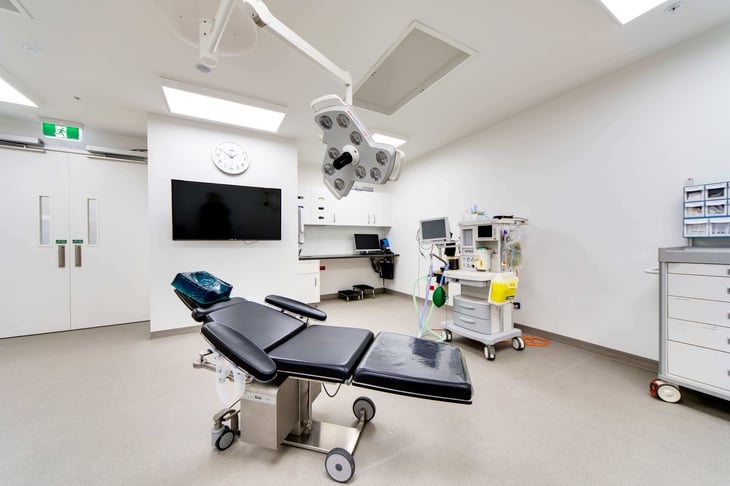
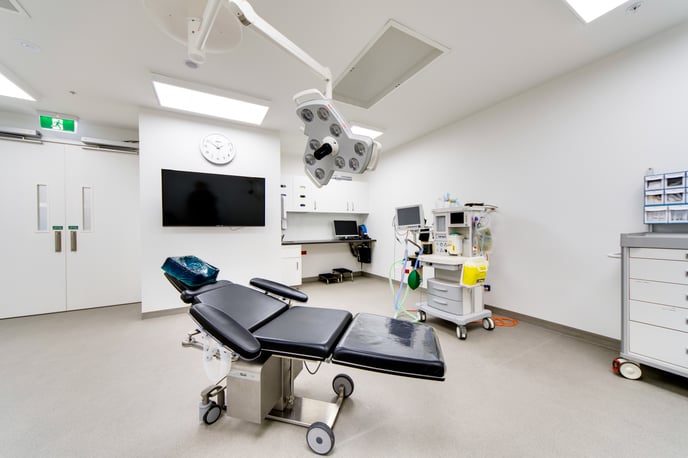
Each room needs to house the procedure table, anaesthetic equipment, instrument trolleys, monitoring equipment, and surgical lighting, while allowing staff to move safely and efficiently.
The layout should enable clear access to the patient from all sides and provide adequate space for emergency situations and support routine documentation, equipment set-up and administrative tasks carried out during procedures.
Recovery Areas
Day stay surgery facilities require staged recovery spaces to manage patients safely from immediately post-procedure through to discharge:
- Stage 1 recovery (PACU): commonly around 9m² per bay, with 1.5 to 3 bays per procedure room depending on case mix and expected throughput. These bays require full monitoring capability and clear sightlines to support continuous staff observation.
- Stage 2 recovery: commonly around 6.5m² per recliner bay, with approximately 3 bays per procedure room. At this stage, patients are typically managed in recliner chairs rather than trolleys.
- Stage 3 discharge lounge: where provided, this is often sized at around 4m² per chair. Smaller practices may discharge patients directly from Stage 2 recovery.
Recovery design should also consider privacy and discharge pathways, including how patients exit the facility safely and are supported back to vehicles or transport.
Undersized recovery areas create bottlenecks that limit daily procedure capacity, so careful planning based on your projected patient volumes and procedure types is important.
Reprocessing facilities
Reprocessing facilities are a common pressure point for both operations and audits if they are not well designed.
Where reusable medical devices are used, the design needs to support reprocessing in line with AS/NZ 5369:2023. This includes clear separation between dirty, clean, and sterile workflows, with a unidirectional flow of instruments that is obvious in both layout and day-to-day practice. Depending on service size, this may be achieved through separate rooms or clearly defined zones.
- The dirty reprocessing area requires suitable sinks for manual cleaning, adequate bench space for handling used instruments, compliant drainage, and ventilation to manage heat, moisture, and chemical exposure.
- The clean reprocessing area must be physically separated from the dirty area and allow space for inspection, assembly, packaging, loading of sterilisers, cooling, and routine monitoring activities. Services with higher throughput may need redundancy in equipment.
- Sterile storage should protect reprocessed instruments from moisture, damage, and contamination. Storage areas need to be easily accessed, clean, well ventilated, and environmentally controlled to maintain packaging integrity until point of use.
For smaller day stay facilities with one or two procedure rooms, reprocessing areas are often around 15–20 m² depending on instrument volumes, case mix, and throughput.

Support Spaces
Beyond clinical areas, your day stay surgery requires adequate support spaces:
- Reception and waiting areas sized for expected patient volumes, with access to suitable toilet facilities.
- Patient change rooms, often at least one per procedure room.
- Secure area to store and manage medications.
- Clean storage with sufficient space for instruments, consumables, and equipment for example 10–20 m² per procedure room, depending on case mix and volumes.
- Dirty utility areas for waste management and soiled items, clearly separated from clean areas.
- Staff amenities, including change rooms, staff rooms, and work areas.
Building Services and Infrastructure
Building services need to support safe care, staff comfort, and reliable day-to-day operation. Plant and equipment placement also needs early consideration because location of HVAC plant, compressors, vacuum systems, and other services can affect noise, heat, maintenance access, and compliance with building and council requirements.
HVAC Systems
HVAC design for procedure rooms needs to reflect procedure risk, equipment load, and expected throughput. HVAC is a major cost item so getting it right upfront matters.
Key considerations typically include:
- Air changes per hour appropriate to the room type and procedure risk
- Temperature control between 20-24°C
- Humidity control, commonly around 50-60%
- Pressure relationships that protect clean areas
- Filtration appropriate to scope including HEPA
Reprocessing areas generate heat from autoclaves and may produce fumes from cleaning agents and sterilisation processes, requiring dedicated ventilation.
Recovery areas similarly need adequate fresh air supply and comfort cooling to support patient recovery.
Medical Gases
Medical gas outlets must be provided at each procedure bay and recovery space:
- Oxygen
- Medical air
- Suction (medical vacuum)
- Anaesthetic gas scavenging where general anaesthesia is administered
These systems require installation by licensed gas fitters and must be tested and certified before the facility can operate.
Electrical and Data Infrastructure
Patient treatment areas are generally designed as body-protected electrical environments, in line with AS/NZS 3000.
You will need to consider:
- Sufficient power outlets for all equipment and not rely on the use of power boards or extensions which create safety and compliance risk.
- Uninterruptible power supply for critical equipment and IT systems.
- Emergency lighting and power backup.
- Appropriate circuit protection.
Procedure rooms typically need 12-16 double power outlets around the room perimeter, with additional ceiling-mounted outlets if you're using pendant systems. Placement will depend on room layout and use.
Contemporary healthcare architecture also requires robust IT infrastructure:
- Network access for electronic medical records and practice management systems
- Comprehensive WiFi coverage
- Nurse call or staff alert systems in procedure and recovery areas
- Telephone and communication points
- Provision for telehealth, remote consultations, teaching or management functions where relevant
Infection Prevention and Control Through Design
Infection prevention is a core consideration in the design of day stay facilities and the physical environment should support safe care, minimise contamination risk, and enable good practice to be consistently followed.
You need to think about how people, equipment, instruments, and waste move through the space. The physical layout should support clear separation between clean and dirty activities across the facility, not just within reprocessing areas. Clean supplies, used instruments, and waste should not cross unnecessarily.
Hand hygiene placement should reflect workflow and provide easy access at key points of care. Hand hygiene stations need to be positioned to support workflow and timely hand hygiene, without introducing splash or contamination risks into clean or clinical areas or requiring staff to move through other spaces to access them. The standards specify required intervals for handwashing facilities based on the layout and workflow patterns.
Surface finishes in clinical areas must be impervious, easily cleaned, and durable. Procedure rooms typically use:
- Welded vinyl flooring with coved skirting.
- Full-height vinyl wall covering or easily cleanable paint
- Smooth ceilings with appropriate service access
Porous materials, complicated junctions, and surfaces that harbour bacteria should be avoided throughout clinical areas.
Storage design must maintain sterile supplies in climate-controlled conditions, separated from potential contaminants. The layout and environmental controls in storage areas directly affect the sterility assurance of your instrument inventory.
Patient flow, access and site considerations
When planning a day stay facility, patient admission and access need to be considered alongside clinical design. This includes how patients arrive, where and how they are admitted, and how they move through the service before and after procedures.
Admission areas should support privacy, dignity, and efficient processing, particularly where patients are fasting, anxious, or recovering from sedation. Clear separation between admission, clinical, and discharge flows helps reduce congestion and supports patient safety.
Practical access matters. Adequate patient parking, drop-off zones, and proximity to entrances are important, particularly for services providing sedation or anaesthesia. Consider how patients will be escorted on arrival and departure, including accessibility requirements.
Getting Your Fitout Right
Meeting day stay surgery standards requires careful planning and experienced professional input. The complexity of requirements across clinical design, building services, and infection control makes specialist knowledge valuable from the earliest stages of your project.
We specialise in the design and build for procedural services throughout New Zealand. Our team understands the standards that apply to dental surgery and day stay facilities, and we can guide you through the design process to create a space that meets certification requirements while supporting efficient clinical operations.
From initial space planning through to equipment specification and certification support, we work with practitioners to deliver end-to-end projects that work both clinically and commercially. Get in touch to discuss your project and how we can help ensure your medical project meets the required standards from day one.